

Therapist Resource Shop
A collection of thoughtfully designed, practical, and easy-to-use resources that I would genuinely use in my own sessions
Anxiety & Stress
Some sessions arrive with a clear focus. Others arrive as everything at once. You do not have to follow every thread.
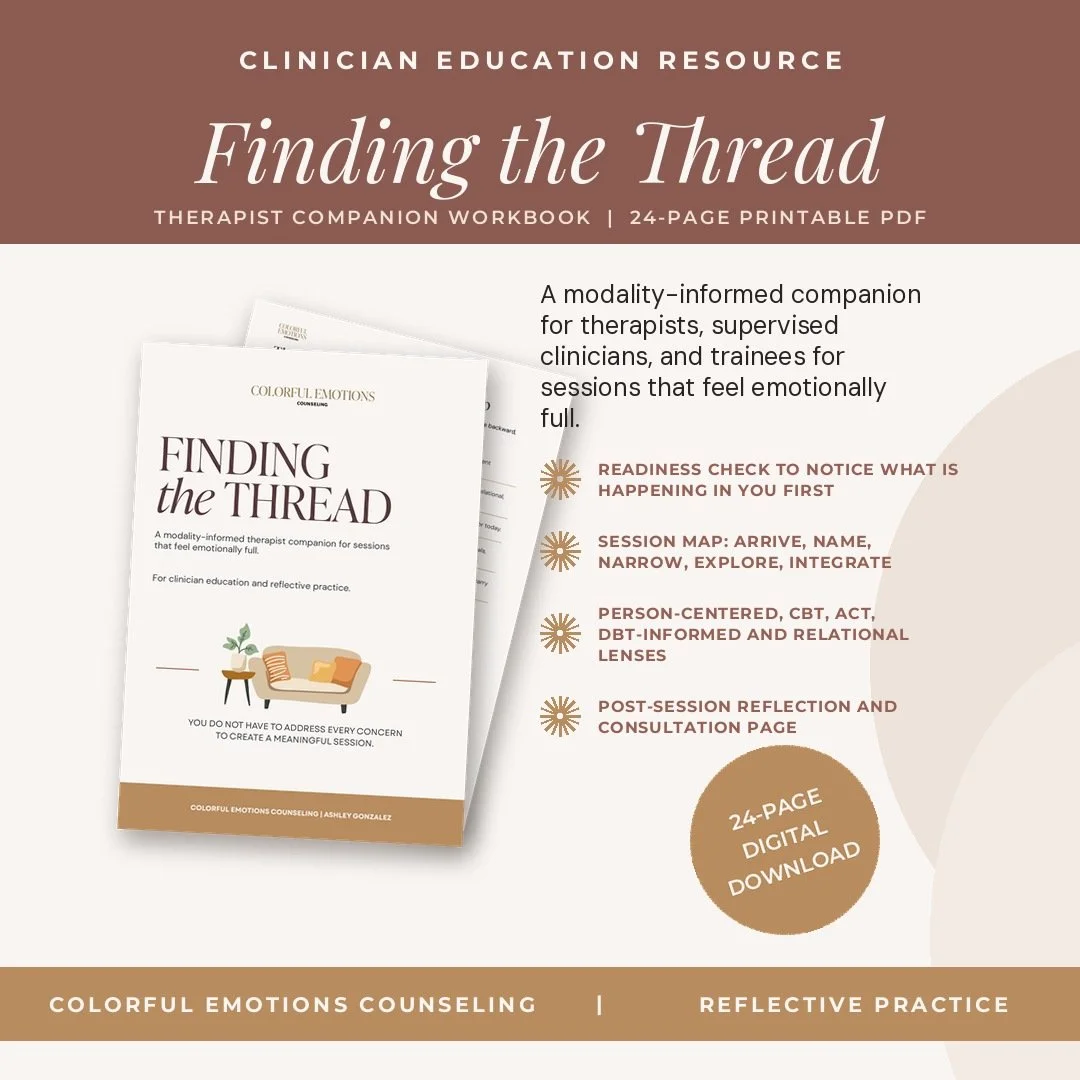
Finding the Thread is a modality-informed therapist companion workbook for sessions that feel emotionally full. It gives you a flexible structure for noticing what is happening in you, helping a client name what is present, narrowing to one workable focus, and closing with care. Created for clinician education and reflective practice.
WHAT THIS WORKBOOK HELPS YOU DO
Check in with yourself first: The Therapist Readiness Check helps you notice your body, your urge to fix or reassure, and what belongs to you and what belongs to the client before you decide what the client needs.
Follow a flexible session map: Move through Arrive, Name, Narrow, Explore, and Integrate and Close. It is an orientation, not a script, and sessions can move backward or repeat a step.
Name the layers: Use the Map the Layers worksheet to sort a client's situation, thoughts, emotions, body response, context, and needs, and to hold a tentative thread.
Choose a workable focus: Select one meaningful focus for today and note what you are intentionally not trying to solve.
Explore through a lens: Use prompts, example responses, and mini maps for Person-Centered, CBT, ACT, DBT-informed, and Relational and Contextual approaches, each with a practice caution.
Reflect and prepare for consultation: Use the Post-Session Reflection and Consultation pages to examine your choices and bring a specific question to supervision.
WHAT'S INCLUDED
24-page printable PDF workbook (A4)
Therapist Readiness Check with grounding cue
Finding the Thread Session Map and step pages with sample prompts
Regulate Without Forcing Calm page, Map the Layers worksheet, and Choose a Workable Focus page
Five lens pages: Person-Centered, CBT, ACT, DBT-informed, and Relational and Contextual
Step Five: Integrate and Close with a closing summary template
Post-Session Reflection and Consultation pages
Scope and intended use notice and table of contents
Delivery: Instant digital download. No physical item will be shipped.
WHO IS THIS FOR?
Licensed behavioral health professionals, supervised clinicians, graduate trainees, and other qualified helping professionals who support clients experiencing emotional overwhelm. This is a therapist-facing resource and is not intended for clients to use on their own.
HOW TO USE
1. Purchase and download your PDF.
2. Print it or fill it in with a PDF or note-taking app.
3. Use it before a session, after a session, in case consultation, or as a teaching resource in supervision. It does not need to be completed in front of every client or followed in a rigid order.
IMPORTANT INFORMATION
This workbook is for clinician education and reflective practice only. It is a supplemental resource and is not a diagnostic manual, medical protocol, or comprehensive training program, and it does not replace clinical judgment, supervision, consultation, or formal education. Professionals are responsible for practicing within the scope of their licensure, certification, and training, and for adapting language to each client. Colorful Emotions Counseling and the author make no guarantees about clinical outcomes. © 2026 Colorful Emotions Counseling. Personal use only. Not for resale, sharing, or redistribution.
Some sessions arrive with a clear focus. Others arrive as everything at once. You do not have to follow every thread.
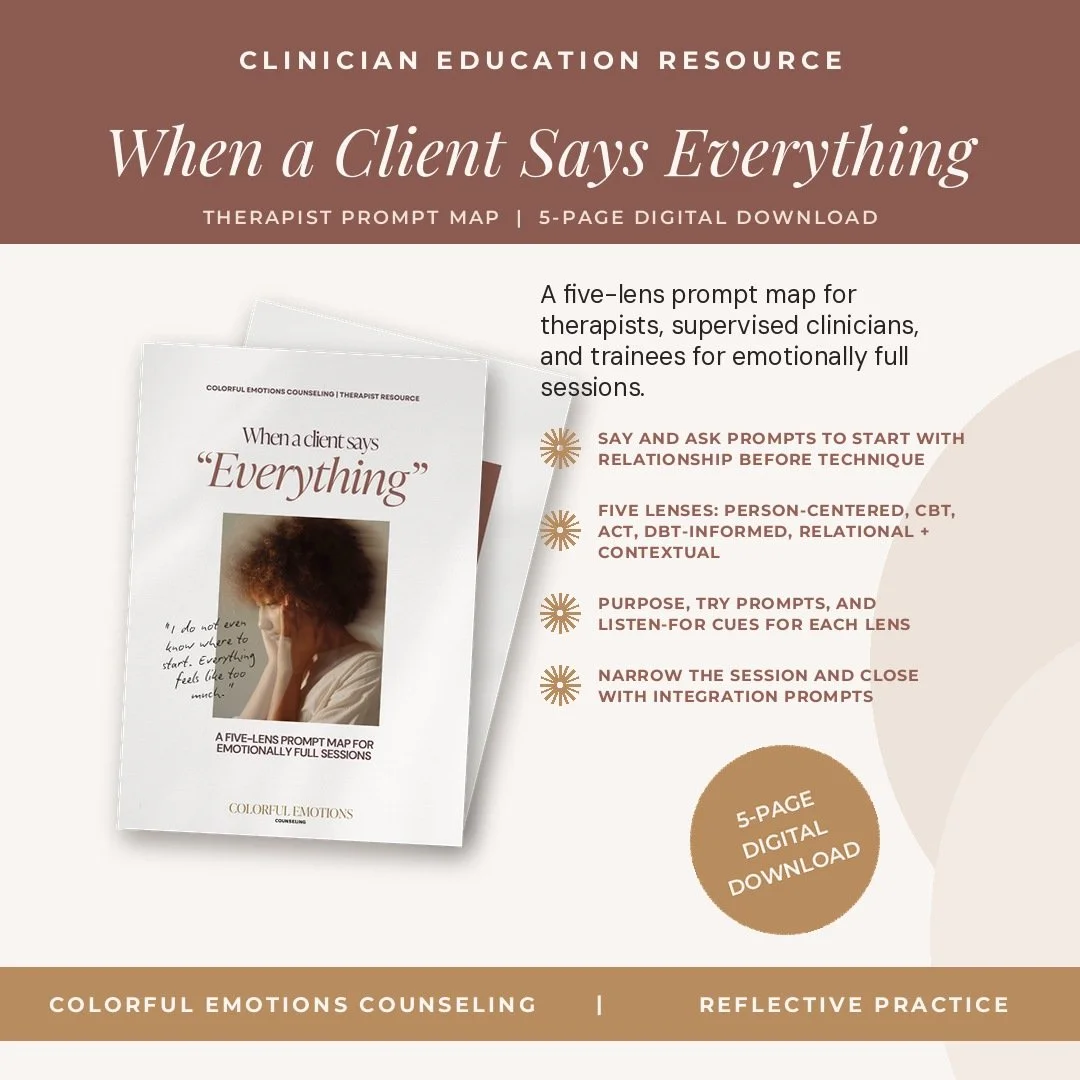
When a Client Says "Everything" is a five-lens prompt map for emotionally full sessions. This 5-page resource gives you simple starting language, five modality-informed lenses with ready-to-use prompts, and a way to narrow the session and close with integration. Created for clinician education and reflective support.
WHAT THIS PROMPT MAP HELPS YOU DO
Start with relationship before technique: Use the Say and Then ask prompts to reflect the weight of the moment and invite the client to choose how to begin.
Pause before choosing a technique: Clarify what the client needs and select one lens that fits the client's goal, readiness, context, and your competence.
Explore through five lenses: Each lens includes a purpose, three Try prompts, and Listen for cues to guide your attention.
Narrow the session: Use the Narrow the Session prompts to find the part with the most emotional weight today.
Close with integration: Use the closing questions to help the client notice what feels clearer, what to carry forward, and what still needs room in a future session.
WHAT'S INCLUDED
5-page digital PDF prompt map (A4)
Cover page and a Start Here page: Relationship Before Technique, with Say and Then ask prompts
Five lens pages, each with Purpose, Try prompts, and Listen for cues: Person-Centered, CBT, ACT, DBT-Informed, and Relational + Contextual
Narrow the Session prompts
Close with Integration prompts
Clinician-use disclaimer
Delivery: Instant digital download. No physical item will be shipped.
WHO IS THIS FOR?
Licensed behavioral health professionals, supervised clinicians, graduate trainees, and other qualified helping professionals who support clients through emotionally full sessions. This is a therapist-facing resource and is not intended for clients to use on their own.
HOW TO USE
1. Purchase and download your PDF.
2. Print it, or keep it open on a tablet or computer.
3. Use it before a session, during a session as a quick reference, after a session, or as a teaching resource in supervision. Choose one lens intentionally. The goal is not to perform every modality in one session.
IMPORTANT INFORMATION
This resource is for clinician education and reflective support only. It is not a diagnostic instrument, treatment plan, documentation standard, risk-assessment or crisis protocol, or substitute for training, supervision, consultation, clinical judgment, or applicable legal and ethical requirements. Use only within your competence and adapt to each client's goals, identity, culture, needs, context, and consent. Follow your established safety procedures whenever risk concerns arise. Colorful Emotions Counseling and the author make no guarantees about clinical outcomes. © 2026 Colorful Emotions Counseling. Individual purchaser use only. Do not copy, share, resell, or redistribute.
Mom Burnout & Mental Load
Love your baby but feel like everything is a lot right now? More than one thing can be true.
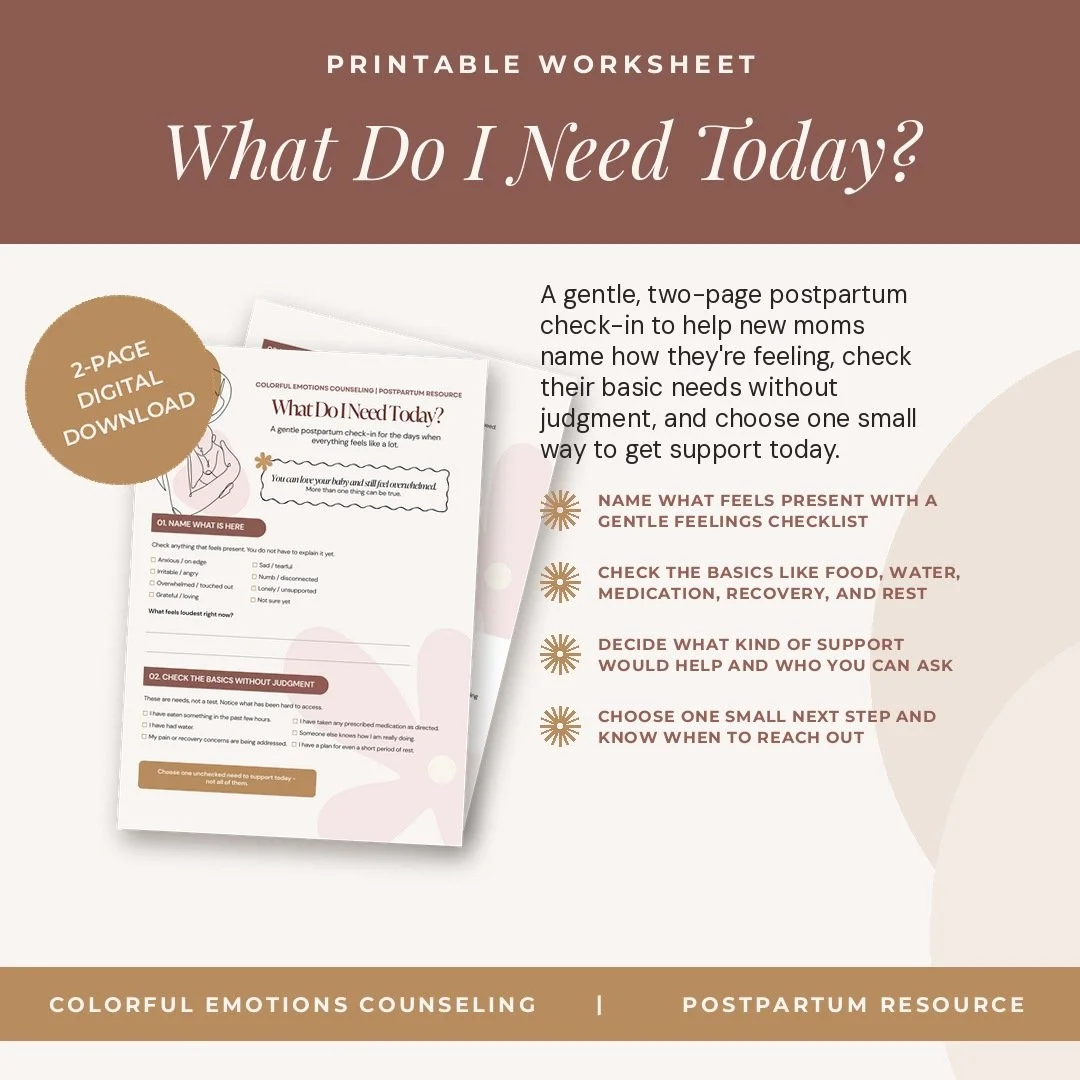
What Do I Need Today? is a gentle, two-page postpartum check-in that helps you notice how you're feeling, check your basic needs without judgment, and choose one small way to get support today.
WHAT THIS WORKSHEET HELPS YOU DO
Name what is here: Check off what you're feeling, like anxious, sad, irritable, numb, touched out, lonely, or grateful, and notice what feels loudest.
Check the basics without judgment: Look at food, water, medication, rest, recovery, and whether someone knows how you're really doing. Then pick just one need to support today.
Find the right support: Decide what would actually help, from someone to listen to an hour of sleep or help with baby care, and name who you can ask.
Choose one small next step: Use the fill-in script to ask for help ("I am having a harder day than I let on. Could you ___ today?") and note anything you want to tell your provider.
Know when to reach out: Clear guidance on when to contact a professional, plus urgent warning signs and 24/7 crisis resources.
WHAT'S INCLUDED
Two-page printable PDF worksheet (A4)
Feelings check-in and basic needs checklist
Support planning prompts and a ready-to-use ask-for-help script
When-to-reach-out guide with 988 and the National Maternal Mental Health Hotline
Delivery: Instant digital download. No physical item will be shipped.
WHO IS THIS FOR?
New and postpartum moms who feel overwhelmed, partners and loved ones who want to support them, and anyone in the fourth trimester who needs a simple way to pause and check in.
HOW TO USE
1. Purchase and download your PDF.
2. Print it or fill it in with a PDF or note-taking app.
3. Take a few quiet minutes to check in, and come back to it whenever a day feels heavy.
IMPORTANT INFORMATION
This worksheet is for personal education and reflection only. It is not a diagnostic tool, medical advice, treatment, or crisis care. If you are in crisis, call or text 988 or call 911. © 2026 Colorful Emotions Counseling. Personal use only.
You don't have to figure it all out today. Just one small next step. 💗
Feeling overwhelmed by everything you have to remember, plan, organize, and manage?
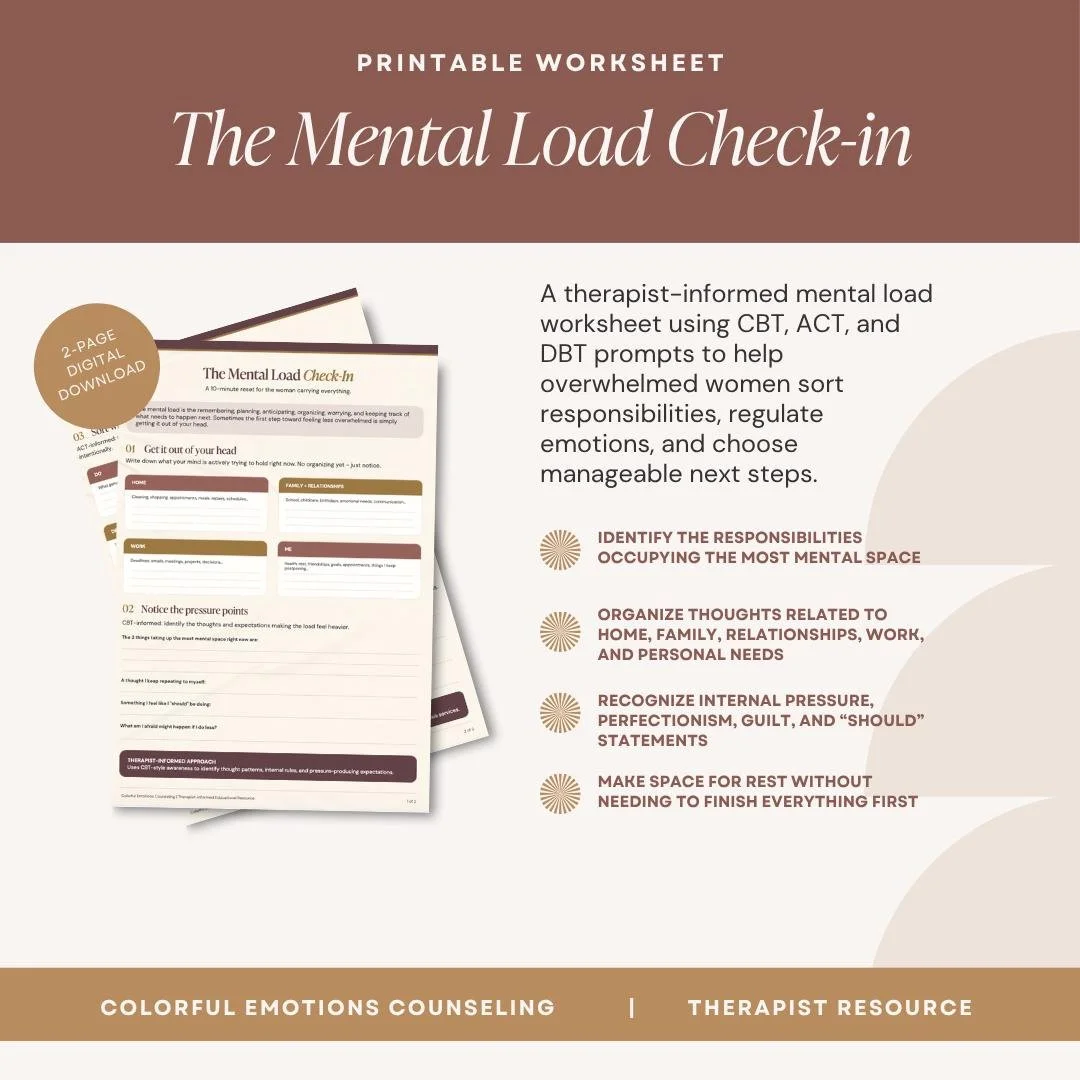
The Mental Load Check-In Worksheet for Women is a printable self-care worksheet designed to help you clear mental clutter, manage overwhelming thoughts, recognize unrealistic expectations, and take a more intentional approach to your daily responsibilities.
Whether you're a busy mom, working woman, caregiver, or someone who feels responsible for keeping everything together, this guided mental health and wellness worksheet offers a simple way to pause, reflect, and decide what truly deserves your energy.
In just 10 minutes, you can complete a mental load brain dump, identify sources of stress, and sort responsibilities into four practical categories: Do, Delegate, Delay, or Drop.
Inspired by principles from Cognitive Behavioral Therapy (CBT), Acceptance and Commitment Therapy (ACT), and Dialectical Behavior Therapy (DBT), this printable provides structured reflection prompts to support emotional awareness, thoughtful decision-making, and values-aligned action.
WHAT THIS MENTAL LOAD WORKSHEET HELPS YOU DO
Clear mental clutter: Get the responsibilities, worries, reminders, and unfinished tasks out of your head and onto paper.
Reduce overwhelm: Identify the thoughts and responsibilities taking up the most mental space.
Recognize perfectionism and guilt: Notice unhelpful “should” statements, internal pressure, and unrealistic expectations.
Organize your responsibilities: Reflect on the mental load associated with home, family, relationships, work, and personal needs.
Prioritize what matters: Use the Do, Delegate, Delay, or Drop method to decide what needs your attention now.
Practice emotional regulation: Follow a brief 60-second reset exercise when you need to pause and regroup.
Ask for support: Identify one specific responsibility you can communicate or ask someone else to help with.
Let go of unnecessary pressure: Choose one expectation you can release instead of trying to do everything.
Make space for rest: Recognize that you deserve rest even when your to-do list isn't finished.
WHAT'S INCLUDED
Your digital download includes:
Two-page Mental Load Check-In printable worksheet
US Letter PDF format (8.5 × 11 inches)
Guided mental load brain-dump prompts
CBT-informed thought-reflection questions
ACT-informed values and decision-making prompts
DBT-informed emotional-regulation support
Do, Delegate, Delay, or Drop planning tool
60-second emotional reset exercise
Asking-for-help reflection prompt
Personal boundaries and expectation-release exercise
One small, values-aligned next-step activity
Format: Printable PDF
Size: US Letter, 8.5 × 11 inches
Delivery: Instant digital download
Physical product: None. No physical item will be shipped.
WHO IS THIS PRINTABLE FOR?
This mental load worksheet may be especially helpful for:
Women who feel mentally overloaded or emotionally drained
Moms managing household responsibilities and invisible labor
Working women balancing career, family, and personal needs
Caregivers who spend much of their time anticipating others' needs
Women navigating stress, perfectionism, or difficulty resting
Individuals who struggle to delegate tasks or ask for help
People looking for a guided self-care or journaling exercise
Therapy clients exploring boundaries, thought patterns, and personal values
Therapists, counselors, coaches, and wellness professionals, subject to the applicable professional-use license
WHEN CAN YOU USE THE MENTAL LOAD CHECK-IN?
Use this printable whenever you need a moment to pause and reassess your responsibilities.
It works well as a quick daily reset, a weekly mental-load check-in, a guided journaling activity, a self-reflection exercise, or preparation for a conversation about sharing responsibilities more fairly.
You can also use it to identify recurring stressors, reflect on personal boundaries, and choose a manageable next step when everything feels equally urgent.
WHY CHOOSE THIS MENTAL LOAD PRINTABLE?
Unlike a traditional to-do list that simply adds tasks to your day, the Mental Load Check-In helps you reflect on the responsibilities and expectations behind your overwhelm.
Instead of asking, “How can I get everything done?” it encourages you to ask:
What is taking up the most space in my mind?
What actually needs my attention right now?
What can I delegate, delay, or let go of?
What support do I need?
What is one small step that aligns with my values?
How can I make room for rest without waiting until everything is finished?
This is a practical, guided reflection tool for creating more clarity and approaching everyday responsibilities with greater intention.
HOW TO USE YOUR DIGITAL DOWNLOAD
1. Purchase and download your printable PDF.
2. Open the file using a compatible PDF viewer.
3. Print on US Letter paper or use it digitally with a compatible note-taking app.
4. Set aside approximately 10 minutes to complete the prompts at your own pace.
5. Revisit the worksheet whenever you need to reassess your mental load.
IMPORTANT INFORMATION
This worksheet is an educational self-reflection and wellness resource informed by selected therapeutic principles. It is not a diagnostic assessment, treatment plan, crisis resource, or substitute for individualized mental health care.
Professional use, including use with clients, groups, or workshops, is subject to the terms of the applicable license.
Give yourself permission to pause. You don't have to carry everything, solve everything, or finish everything today. 💗
Some sessions arrive with a clear focus. Others arrive as everything at once. You do not have to follow every thread.
Finding the Thread is a modality-informed therapist companion workbook for sessions that feel emotionally full. It gives you a flexible structure for noticing what is happening in you, helping a client name what is present, narrowing to one workable focus, and closing with care. Created for clinician education and reflective practice.
WHAT THIS WORKBOOK HELPS YOU DO
Check in with yourself first: The Therapist Readiness Check helps you notice your body, your urge to fix or reassure, and what belongs to you and what belongs to the client before you decide what the client needs.
Follow a flexible session map: Move through Arrive, Name, Narrow, Explore, and Integrate and Close. It is an orientation, not a script, and sessions can move backward or repeat a step.
Name the layers: Use the Map the Layers worksheet to sort a client's situation, thoughts, emotions, body response, context, and needs, and to hold a tentative thread.
Choose a workable focus: Select one meaningful focus for today and note what you are intentionally not trying to solve.
Explore through a lens: Use prompts, example responses, and mini maps for Person-Centered, CBT, ACT, DBT-informed, and Relational and Contextual approaches, each with a practice caution.
Reflect and prepare for consultation: Use the Post-Session Reflection and Consultation pages to examine your choices and bring a specific question to supervision.
WHAT'S INCLUDED
24-page printable PDF workbook (A4)
Therapist Readiness Check with grounding cue
Finding the Thread Session Map and step pages with sample prompts
Regulate Without Forcing Calm page, Map the Layers worksheet, and Choose a Workable Focus page
Five lens pages: Person-Centered, CBT, ACT, DBT-informed, and Relational and Contextual
Step Five: Integrate and Close with a closing summary template
Post-Session Reflection and Consultation pages
Scope and intended use notice and table of contents
Delivery: Instant digital download. No physical item will be shipped.
WHO IS THIS FOR?
Licensed behavioral health professionals, supervised clinicians, graduate trainees, and other qualified helping professionals who support clients experiencing emotional overwhelm. This is a therapist-facing resource and is not intended for clients to use on their own.
HOW TO USE
1. Purchase and download your PDF.
2. Print it or fill it in with a PDF or note-taking app.
3. Use it before a session, after a session, in case consultation, or as a teaching resource in supervision. It does not need to be completed in front of every client or followed in a rigid order.
IMPORTANT INFORMATION
This workbook is for clinician education and reflective practice only. It is a supplemental resource and is not a diagnostic manual, medical protocol, or comprehensive training program, and it does not replace clinical judgment, supervision, consultation, or formal education. Professionals are responsible for practicing within the scope of their licensure, certification, and training, and for adapting language to each client. Colorful Emotions Counseling and the author make no guarantees about clinical outcomes. © 2026 Colorful Emotions Counseling. Personal use only. Not for resale, sharing, or redistribution.
Some sessions arrive with a clear focus. Others arrive as everything at once. You do not have to follow every thread.
When a Client Says "Everything" is a five-lens prompt map for emotionally full sessions. This 5-page resource gives you simple starting language, five modality-informed lenses with ready-to-use prompts, and a way to narrow the session and close with integration. Created for clinician education and reflective support.
WHAT THIS PROMPT MAP HELPS YOU DO
Start with relationship before technique: Use the Say and Then ask prompts to reflect the weight of the moment and invite the client to choose how to begin.
Pause before choosing a technique: Clarify what the client needs and select one lens that fits the client's goal, readiness, context, and your competence.
Explore through five lenses: Each lens includes a purpose, three Try prompts, and Listen for cues to guide your attention.
Narrow the session: Use the Narrow the Session prompts to find the part with the most emotional weight today.
Close with integration: Use the closing questions to help the client notice what feels clearer, what to carry forward, and what still needs room in a future session.
WHAT'S INCLUDED
5-page digital PDF prompt map (A4)
Cover page and a Start Here page: Relationship Before Technique, with Say and Then ask prompts
Five lens pages, each with Purpose, Try prompts, and Listen for cues: Person-Centered, CBT, ACT, DBT-Informed, and Relational + Contextual
Narrow the Session prompts
Close with Integration prompts
Clinician-use disclaimer
Delivery: Instant digital download. No physical item will be shipped.
WHO IS THIS FOR?
Licensed behavioral health professionals, supervised clinicians, graduate trainees, and other qualified helping professionals who support clients through emotionally full sessions. This is a therapist-facing resource and is not intended for clients to use on their own.
HOW TO USE
1. Purchase and download your PDF.
2. Print it, or keep it open on a tablet or computer.
3. Use it before a session, during a session as a quick reference, after a session, or as a teaching resource in supervision. Choose one lens intentionally. The goal is not to perform every modality in one session.
IMPORTANT INFORMATION
This resource is for clinician education and reflective support only. It is not a diagnostic instrument, treatment plan, documentation standard, risk-assessment or crisis protocol, or substitute for training, supervision, consultation, clinical judgment, or applicable legal and ethical requirements. Use only within your competence and adapt to each client's goals, identity, culture, needs, context, and consent. Follow your established safety procedures whenever risk concerns arise. Colorful Emotions Counseling and the author make no guarantees about clinical outcomes. © 2026 Colorful Emotions Counseling. Individual purchaser use only. Do not copy, share, resell, or redistribute.
Pregnancy & Postpartum
Love your baby but feel like everything is a lot right now? More than one thing can be true.
What Do I Need Today? is a gentle, two-page postpartum check-in that helps you notice how you're feeling, check your basic needs without judgment, and choose one small way to get support today.
WHAT THIS WORKSHEET HELPS YOU DO
Name what is here: Check off what you're feeling, like anxious, sad, irritable, numb, touched out, lonely, or grateful, and notice what feels loudest.
Check the basics without judgment: Look at food, water, medication, rest, recovery, and whether someone knows how you're really doing. Then pick just one need to support today.
Find the right support: Decide what would actually help, from someone to listen to an hour of sleep or help with baby care, and name who you can ask.
Choose one small next step: Use the fill-in script to ask for help ("I am having a harder day than I let on. Could you ___ today?") and note anything you want to tell your provider.
Know when to reach out: Clear guidance on when to contact a professional, plus urgent warning signs and 24/7 crisis resources.
WHAT'S INCLUDED
Two-page printable PDF worksheet (A4)
Feelings check-in and basic needs checklist
Support planning prompts and a ready-to-use ask-for-help script
When-to-reach-out guide with 988 and the National Maternal Mental Health Hotline
Delivery: Instant digital download. No physical item will be shipped.
WHO IS THIS FOR?
New and postpartum moms who feel overwhelmed, partners and loved ones who want to support them, and anyone in the fourth trimester who needs a simple way to pause and check in.
HOW TO USE
1. Purchase and download your PDF.
2. Print it or fill it in with a PDF or note-taking app.
3. Take a few quiet minutes to check in, and come back to it whenever a day feels heavy.
IMPORTANT INFORMATION
This worksheet is for personal education and reflection only. It is not a diagnostic tool, medical advice, treatment, or crisis care. If you are in crisis, call or text 988 or call 911. © 2026 Colorful Emotions Counseling. Personal use only.
You don't have to figure it all out today. Just one small next step. 💗
Some sessions arrive with a clear focus. Others arrive as everything at once. You do not have to follow every thread.
Finding the Thread is a modality-informed therapist companion workbook for sessions that feel emotionally full. It gives you a flexible structure for noticing what is happening in you, helping a client name what is present, narrowing to one workable focus, and closing with care. Created for clinician education and reflective practice.
WHAT THIS WORKBOOK HELPS YOU DO
Check in with yourself first: The Therapist Readiness Check helps you notice your body, your urge to fix or reassure, and what belongs to you and what belongs to the client before you decide what the client needs.
Follow a flexible session map: Move through Arrive, Name, Narrow, Explore, and Integrate and Close. It is an orientation, not a script, and sessions can move backward or repeat a step.
Name the layers: Use the Map the Layers worksheet to sort a client's situation, thoughts, emotions, body response, context, and needs, and to hold a tentative thread.
Choose a workable focus: Select one meaningful focus for today and note what you are intentionally not trying to solve.
Explore through a lens: Use prompts, example responses, and mini maps for Person-Centered, CBT, ACT, DBT-informed, and Relational and Contextual approaches, each with a practice caution.
Reflect and prepare for consultation: Use the Post-Session Reflection and Consultation pages to examine your choices and bring a specific question to supervision.
WHAT'S INCLUDED
24-page printable PDF workbook (A4)
Therapist Readiness Check with grounding cue
Finding the Thread Session Map and step pages with sample prompts
Regulate Without Forcing Calm page, Map the Layers worksheet, and Choose a Workable Focus page
Five lens pages: Person-Centered, CBT, ACT, DBT-informed, and Relational and Contextual
Step Five: Integrate and Close with a closing summary template
Post-Session Reflection and Consultation pages
Scope and intended use notice and table of contents
Delivery: Instant digital download. No physical item will be shipped.
WHO IS THIS FOR?
Licensed behavioral health professionals, supervised clinicians, graduate trainees, and other qualified helping professionals who support clients experiencing emotional overwhelm. This is a therapist-facing resource and is not intended for clients to use on their own.
HOW TO USE
1. Purchase and download your PDF.
2. Print it or fill it in with a PDF or note-taking app.
3. Use it before a session, after a session, in case consultation, or as a teaching resource in supervision. It does not need to be completed in front of every client or followed in a rigid order.
IMPORTANT INFORMATION
This workbook is for clinician education and reflective practice only. It is a supplemental resource and is not a diagnostic manual, medical protocol, or comprehensive training program, and it does not replace clinical judgment, supervision, consultation, or formal education. Professionals are responsible for practicing within the scope of their licensure, certification, and training, and for adapting language to each client. Colorful Emotions Counseling and the author make no guarantees about clinical outcomes. © 2026 Colorful Emotions Counseling. Personal use only. Not for resale, sharing, or redistribution.
Some sessions arrive with a clear focus. Others arrive as everything at once. You do not have to follow every thread.
When a Client Says "Everything" is a five-lens prompt map for emotionally full sessions. This 5-page resource gives you simple starting language, five modality-informed lenses with ready-to-use prompts, and a way to narrow the session and close with integration. Created for clinician education and reflective support.
WHAT THIS PROMPT MAP HELPS YOU DO
Start with relationship before technique: Use the Say and Then ask prompts to reflect the weight of the moment and invite the client to choose how to begin.
Pause before choosing a technique: Clarify what the client needs and select one lens that fits the client's goal, readiness, context, and your competence.
Explore through five lenses: Each lens includes a purpose, three Try prompts, and Listen for cues to guide your attention.
Narrow the session: Use the Narrow the Session prompts to find the part with the most emotional weight today.
Close with integration: Use the closing questions to help the client notice what feels clearer, what to carry forward, and what still needs room in a future session.
WHAT'S INCLUDED
5-page digital PDF prompt map (A4)
Cover page and a Start Here page: Relationship Before Technique, with Say and Then ask prompts
Five lens pages, each with Purpose, Try prompts, and Listen for cues: Person-Centered, CBT, ACT, DBT-Informed, and Relational + Contextual
Narrow the Session prompts
Close with Integration prompts
Clinician-use disclaimer
Delivery: Instant digital download. No physical item will be shipped.
WHO IS THIS FOR?
Licensed behavioral health professionals, supervised clinicians, graduate trainees, and other qualified helping professionals who support clients through emotionally full sessions. This is a therapist-facing resource and is not intended for clients to use on their own.
HOW TO USE
1. Purchase and download your PDF.
2. Print it, or keep it open on a tablet or computer.
3. Use it before a session, during a session as a quick reference, after a session, or as a teaching resource in supervision. Choose one lens intentionally. The goal is not to perform every modality in one session.
IMPORTANT INFORMATION
This resource is for clinician education and reflective support only. It is not a diagnostic instrument, treatment plan, documentation standard, risk-assessment or crisis protocol, or substitute for training, supervision, consultation, clinical judgment, or applicable legal and ethical requirements. Use only within your competence and adapt to each client's goals, identity, culture, needs, context, and consent. Follow your established safety procedures whenever risk concerns arise. Colorful Emotions Counseling and the author make no guarantees about clinical outcomes. © 2026 Colorful Emotions Counseling. Individual purchaser use only. Do not copy, share, resell, or redistribute.
Infertility
Some sessions arrive with a clear focus. Others arrive as everything at once. You do not have to follow every thread.
Finding the Thread is a modality-informed therapist companion workbook for sessions that feel emotionally full. It gives you a flexible structure for noticing what is happening in you, helping a client name what is present, narrowing to one workable focus, and closing with care. Created for clinician education and reflective practice.
WHAT THIS WORKBOOK HELPS YOU DO
Check in with yourself first: The Therapist Readiness Check helps you notice your body, your urge to fix or reassure, and what belongs to you and what belongs to the client before you decide what the client needs.
Follow a flexible session map: Move through Arrive, Name, Narrow, Explore, and Integrate and Close. It is an orientation, not a script, and sessions can move backward or repeat a step.
Name the layers: Use the Map the Layers worksheet to sort a client's situation, thoughts, emotions, body response, context, and needs, and to hold a tentative thread.
Choose a workable focus: Select one meaningful focus for today and note what you are intentionally not trying to solve.
Explore through a lens: Use prompts, example responses, and mini maps for Person-Centered, CBT, ACT, DBT-informed, and Relational and Contextual approaches, each with a practice caution.
Reflect and prepare for consultation: Use the Post-Session Reflection and Consultation pages to examine your choices and bring a specific question to supervision.
WHAT'S INCLUDED
24-page printable PDF workbook (A4)
Therapist Readiness Check with grounding cue
Finding the Thread Session Map and step pages with sample prompts
Regulate Without Forcing Calm page, Map the Layers worksheet, and Choose a Workable Focus page
Five lens pages: Person-Centered, CBT, ACT, DBT-informed, and Relational and Contextual
Step Five: Integrate and Close with a closing summary template
Post-Session Reflection and Consultation pages
Scope and intended use notice and table of contents
Delivery: Instant digital download. No physical item will be shipped.
WHO IS THIS FOR?
Licensed behavioral health professionals, supervised clinicians, graduate trainees, and other qualified helping professionals who support clients experiencing emotional overwhelm. This is a therapist-facing resource and is not intended for clients to use on their own.
HOW TO USE
1. Purchase and download your PDF.
2. Print it or fill it in with a PDF or note-taking app.
3. Use it before a session, after a session, in case consultation, or as a teaching resource in supervision. It does not need to be completed in front of every client or followed in a rigid order.
IMPORTANT INFORMATION
This workbook is for clinician education and reflective practice only. It is a supplemental resource and is not a diagnostic manual, medical protocol, or comprehensive training program, and it does not replace clinical judgment, supervision, consultation, or formal education. Professionals are responsible for practicing within the scope of their licensure, certification, and training, and for adapting language to each client. Colorful Emotions Counseling and the author make no guarantees about clinical outcomes. © 2026 Colorful Emotions Counseling. Personal use only. Not for resale, sharing, or redistribution.
Some sessions arrive with a clear focus. Others arrive as everything at once. You do not have to follow every thread.
When a Client Says "Everything" is a five-lens prompt map for emotionally full sessions. This 5-page resource gives you simple starting language, five modality-informed lenses with ready-to-use prompts, and a way to narrow the session and close with integration. Created for clinician education and reflective support.
WHAT THIS PROMPT MAP HELPS YOU DO
Start with relationship before technique: Use the Say and Then ask prompts to reflect the weight of the moment and invite the client to choose how to begin.
Pause before choosing a technique: Clarify what the client needs and select one lens that fits the client's goal, readiness, context, and your competence.
Explore through five lenses: Each lens includes a purpose, three Try prompts, and Listen for cues to guide your attention.
Narrow the session: Use the Narrow the Session prompts to find the part with the most emotional weight today.
Close with integration: Use the closing questions to help the client notice what feels clearer, what to carry forward, and what still needs room in a future session.
WHAT'S INCLUDED
5-page digital PDF prompt map (A4)
Cover page and a Start Here page: Relationship Before Technique, with Say and Then ask prompts
Five lens pages, each with Purpose, Try prompts, and Listen for cues: Person-Centered, CBT, ACT, DBT-Informed, and Relational + Contextual
Narrow the Session prompts
Close with Integration prompts
Clinician-use disclaimer
Delivery: Instant digital download. No physical item will be shipped.
WHO IS THIS FOR?
Licensed behavioral health professionals, supervised clinicians, graduate trainees, and other qualified helping professionals who support clients through emotionally full sessions. This is a therapist-facing resource and is not intended for clients to use on their own.
HOW TO USE
1. Purchase and download your PDF.
2. Print it, or keep it open on a tablet or computer.
3. Use it before a session, during a session as a quick reference, after a session, or as a teaching resource in supervision. Choose one lens intentionally. The goal is not to perform every modality in one session.
IMPORTANT INFORMATION
This resource is for clinician education and reflective support only. It is not a diagnostic instrument, treatment plan, documentation standard, risk-assessment or crisis protocol, or substitute for training, supervision, consultation, clinical judgment, or applicable legal and ethical requirements. Use only within your competence and adapt to each client's goals, identity, culture, needs, context, and consent. Follow your established safety procedures whenever risk concerns arise. Colorful Emotions Counseling and the author make no guarantees about clinical outcomes. © 2026 Colorful Emotions Counseling. Individual purchaser use only. Do not copy, share, resell, or redistribute.
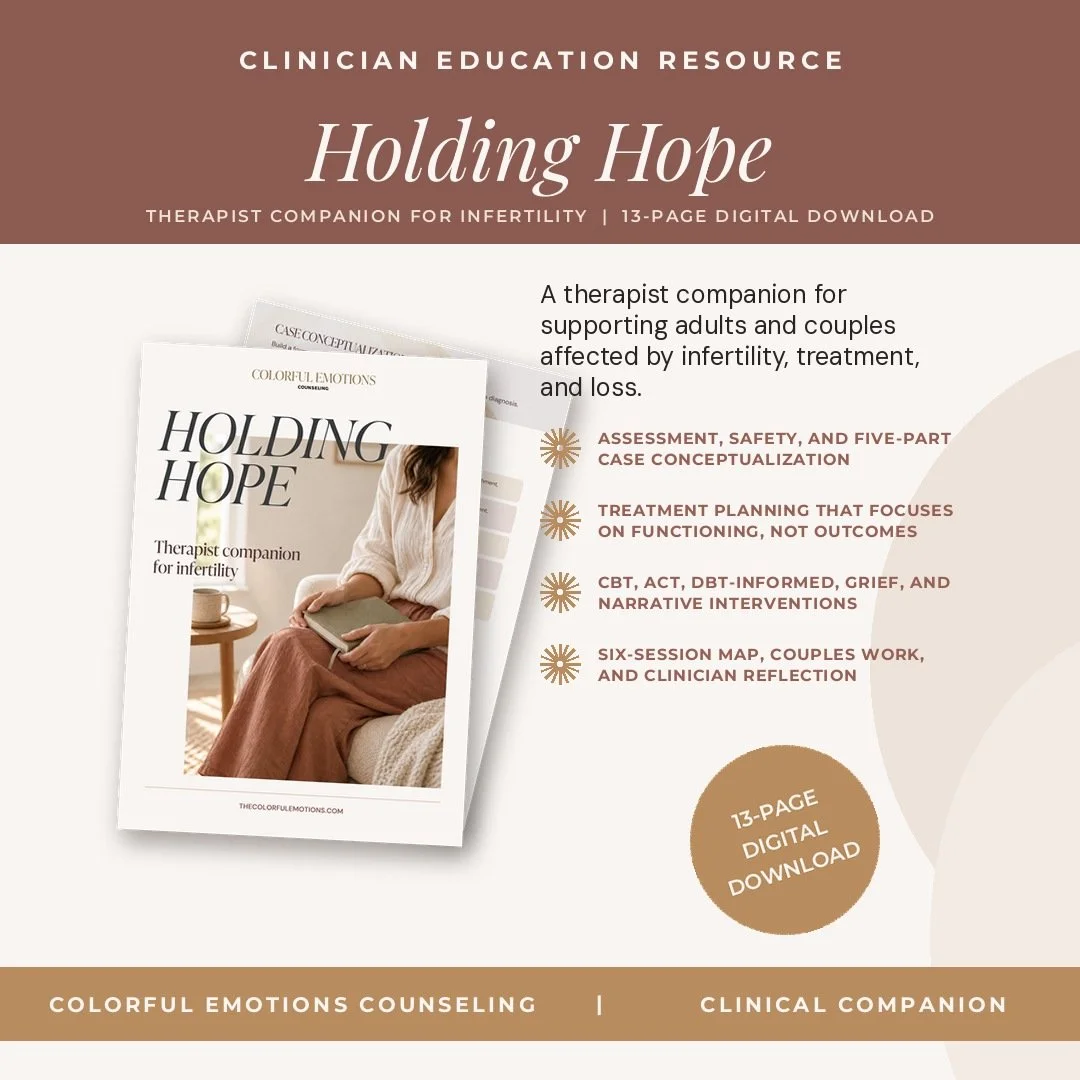
Infertility can bring grief, uncertainty, strain, and a long list of decisions into the therapy room. You do not have to build your approach from scratch.
Holding Hope: Therapist Companion for Infertility is a 13-page clinician workbook for supporting adults and couples affected by infertility, fertility treatment, reproductive loss, and family-building uncertainty. It brings together assessment domains, a five-part case formulation, treatment planning examples, an intervention menu, a six-session example map, couples work, and space for your own reflection. Created for clinician education and reflective support.
WHAT THIS WORKBOOK HELPS YOU DO
Understand the whole picture first: Use the Clinical Presentation & Context page to slow down and ask how infertility is affecting the client emotionally, mentally, relationally, and socially before considering a diagnosis.
Organize your assessment: Review sample domains including presenting concern, symptoms and function, grief and loss, risk, treatment context, supports, and culture and identity.
Build a formulation: Use the five-part formulation (predisposing, precipitating, perpetuating, protective, and presenting pattern) and a working hypothesis space.
Plan around functioning and values: See sample goals, possible objectives, and possible interventions, along with guidance on avoiding outcome-linked goals.
Select interventions collaboratively: Browse a menu of CBT-informed, ACT-informed, DBT-informed, and grief and narrative options.
Support couples and your own practice: Use the couples work page for patterns to assess, structured dialogue, and referral considerations, then reflect on your own assumptions, limits, and need for consultation.
WHAT'S INCLUDED
13-page digital PDF workbook (A4)
Cover, Welcome, Scope & Intended Use, and Copyright Notice
Clinical Presentation & Context
Assessment & Safety: Initial Assessment Domains and notes on measures
Case Conceptualization: Five-Part Formulation and Working Hypothesis space
Treatment Planning: Sample Goals and Objectives, and Avoid Outcome-Linked Goals guidance
Intervention Menu: CBT-informed, ACT-informed, DBT-informed, and Grief and Narrative
Session Map: a flexible six-session example
Couples Work: Patterns to Assess, Structured Dialogue, and Referral Considerations
Clinician Reflection prompts
Selected Evidence Base
Delivery: Instant digital download. No physical item will be shipped.
WHO IS THIS FOR?
Licensed behavioral health professionals, supervised clinicians, graduate trainees, and other qualified helping professionals supporting adults and couples affected by infertility, fertility treatment, reproductive loss, and family-building uncertainty. This is a therapist-facing resource and is not intended for clients to use on their own.
HOW TO USE
1. Purchase and download your PDF.
2. Print it, or keep it open on a tablet or computer.
3. Use it to prepare for a session, organize an assessment or treatment plan, bring a case to supervision, or reflect on your own practice. Choose only what fits the client, the setting, and your competence.
IMPORTANT INFORMATION
This workbook is for clinician education and reflective support only. It is intended solely as a supplemental resource and is not intended to replace professional clinical judgment, supervision, consultation, formal education, diagnostic evaluation, medical advice, legal guidance, or evidence-based treatment planning. It is not a diagnostic manual, medical protocol, or comprehensive competency training program. Mental health professionals are responsible for practicing within the scope of their licensure, certification, training, and applicable ethical and legal standards. Colorful Emotions Counseling and the author make no guarantees regarding clinical outcomes. Mental health treatment can target coping and functioning; it cannot promise a reproductive outcome. © 2026 Colorful Emotions Counseling. Individual purchaser use only. Do not copy, share, resell, or redistribute.
Identity & Life Transitions
Some sessions arrive with a clear focus. Others arrive as everything at once. You do not have to follow every thread.
Finding the Thread is a modality-informed therapist companion workbook for sessions that feel emotionally full. It gives you a flexible structure for noticing what is happening in you, helping a client name what is present, narrowing to one workable focus, and closing with care. Created for clinician education and reflective practice.
WHAT THIS WORKBOOK HELPS YOU DO
Check in with yourself first: The Therapist Readiness Check helps you notice your body, your urge to fix or reassure, and what belongs to you and what belongs to the client before you decide what the client needs.
Follow a flexible session map: Move through Arrive, Name, Narrow, Explore, and Integrate and Close. It is an orientation, not a script, and sessions can move backward or repeat a step.
Name the layers: Use the Map the Layers worksheet to sort a client's situation, thoughts, emotions, body response, context, and needs, and to hold a tentative thread.
Choose a workable focus: Select one meaningful focus for today and note what you are intentionally not trying to solve.
Explore through a lens: Use prompts, example responses, and mini maps for Person-Centered, CBT, ACT, DBT-informed, and Relational and Contextual approaches, each with a practice caution.
Reflect and prepare for consultation: Use the Post-Session Reflection and Consultation pages to examine your choices and bring a specific question to supervision.
WHAT'S INCLUDED
24-page printable PDF workbook (A4)
Therapist Readiness Check with grounding cue
Finding the Thread Session Map and step pages with sample prompts
Regulate Without Forcing Calm page, Map the Layers worksheet, and Choose a Workable Focus page
Five lens pages: Person-Centered, CBT, ACT, DBT-informed, and Relational and Contextual
Step Five: Integrate and Close with a closing summary template
Post-Session Reflection and Consultation pages
Scope and intended use notice and table of contents
Delivery: Instant digital download. No physical item will be shipped.
WHO IS THIS FOR?
Licensed behavioral health professionals, supervised clinicians, graduate trainees, and other qualified helping professionals who support clients experiencing emotional overwhelm. This is a therapist-facing resource and is not intended for clients to use on their own.
HOW TO USE
1. Purchase and download your PDF.
2. Print it or fill it in with a PDF or note-taking app.
3. Use it before a session, after a session, in case consultation, or as a teaching resource in supervision. It does not need to be completed in front of every client or followed in a rigid order.
IMPORTANT INFORMATION
This workbook is for clinician education and reflective practice only. It is a supplemental resource and is not a diagnostic manual, medical protocol, or comprehensive training program, and it does not replace clinical judgment, supervision, consultation, or formal education. Professionals are responsible for practicing within the scope of their licensure, certification, and training, and for adapting language to each client. Colorful Emotions Counseling and the author make no guarantees about clinical outcomes. © 2026 Colorful Emotions Counseling. Personal use only. Not for resale, sharing, or redistribution.
Some sessions arrive with a clear focus. Others arrive as everything at once. You do not have to follow every thread.
When a Client Says "Everything" is a five-lens prompt map for emotionally full sessions. This 5-page resource gives you simple starting language, five modality-informed lenses with ready-to-use prompts, and a way to narrow the session and close with integration. Created for clinician education and reflective support.
WHAT THIS PROMPT MAP HELPS YOU DO
Start with relationship before technique: Use the Say and Then ask prompts to reflect the weight of the moment and invite the client to choose how to begin.
Pause before choosing a technique: Clarify what the client needs and select one lens that fits the client's goal, readiness, context, and your competence.
Explore through five lenses: Each lens includes a purpose, three Try prompts, and Listen for cues to guide your attention.
Narrow the session: Use the Narrow the Session prompts to find the part with the most emotional weight today.
Close with integration: Use the closing questions to help the client notice what feels clearer, what to carry forward, and what still needs room in a future session.
WHAT'S INCLUDED
5-page digital PDF prompt map (A4)
Cover page and a Start Here page: Relationship Before Technique, with Say and Then ask prompts
Five lens pages, each with Purpose, Try prompts, and Listen for cues: Person-Centered, CBT, ACT, DBT-Informed, and Relational + Contextual
Narrow the Session prompts
Close with Integration prompts
Clinician-use disclaimer
Delivery: Instant digital download. No physical item will be shipped.
WHO IS THIS FOR?
Licensed behavioral health professionals, supervised clinicians, graduate trainees, and other qualified helping professionals who support clients through emotionally full sessions. This is a therapist-facing resource and is not intended for clients to use on their own.
HOW TO USE
1. Purchase and download your PDF.
2. Print it, or keep it open on a tablet or computer.
3. Use it before a session, during a session as a quick reference, after a session, or as a teaching resource in supervision. Choose one lens intentionally. The goal is not to perform every modality in one session.
IMPORTANT INFORMATION
This resource is for clinician education and reflective support only. It is not a diagnostic instrument, treatment plan, documentation standard, risk-assessment or crisis protocol, or substitute for training, supervision, consultation, clinical judgment, or applicable legal and ethical requirements. Use only within your competence and adapt to each client's goals, identity, culture, needs, context, and consent. Follow your established safety procedures whenever risk concerns arise. Colorful Emotions Counseling and the author make no guarantees about clinical outcomes. © 2026 Colorful Emotions Counseling. Individual purchaser use only. Do not copy, share, resell, or redistribute.
Relationship Concerns
Some sessions arrive with a clear focus. Others arrive as everything at once. You do not have to follow every thread.
Finding the Thread is a modality-informed therapist companion workbook for sessions that feel emotionally full. It gives you a flexible structure for noticing what is happening in you, helping a client name what is present, narrowing to one workable focus, and closing with care. Created for clinician education and reflective practice.
WHAT THIS WORKBOOK HELPS YOU DO
Check in with yourself first: The Therapist Readiness Check helps you notice your body, your urge to fix or reassure, and what belongs to you and what belongs to the client before you decide what the client needs.
Follow a flexible session map: Move through Arrive, Name, Narrow, Explore, and Integrate and Close. It is an orientation, not a script, and sessions can move backward or repeat a step.
Name the layers: Use the Map the Layers worksheet to sort a client's situation, thoughts, emotions, body response, context, and needs, and to hold a tentative thread.
Choose a workable focus: Select one meaningful focus for today and note what you are intentionally not trying to solve.
Explore through a lens: Use prompts, example responses, and mini maps for Person-Centered, CBT, ACT, DBT-informed, and Relational and Contextual approaches, each with a practice caution.
Reflect and prepare for consultation: Use the Post-Session Reflection and Consultation pages to examine your choices and bring a specific question to supervision.
WHAT'S INCLUDED
24-page printable PDF workbook (A4)
Therapist Readiness Check with grounding cue
Finding the Thread Session Map and step pages with sample prompts
Regulate Without Forcing Calm page, Map the Layers worksheet, and Choose a Workable Focus page
Five lens pages: Person-Centered, CBT, ACT, DBT-informed, and Relational and Contextual
Step Five: Integrate and Close with a closing summary template
Post-Session Reflection and Consultation pages
Scope and intended use notice and table of contents
Delivery: Instant digital download. No physical item will be shipped.
WHO IS THIS FOR?
Licensed behavioral health professionals, supervised clinicians, graduate trainees, and other qualified helping professionals who support clients experiencing emotional overwhelm. This is a therapist-facing resource and is not intended for clients to use on their own.
HOW TO USE
1. Purchase and download your PDF.
2. Print it or fill it in with a PDF or note-taking app.
3. Use it before a session, after a session, in case consultation, or as a teaching resource in supervision. It does not need to be completed in front of every client or followed in a rigid order.
IMPORTANT INFORMATION
This workbook is for clinician education and reflective practice only. It is a supplemental resource and is not a diagnostic manual, medical protocol, or comprehensive training program, and it does not replace clinical judgment, supervision, consultation, or formal education. Professionals are responsible for practicing within the scope of their licensure, certification, and training, and for adapting language to each client. Colorful Emotions Counseling and the author make no guarantees about clinical outcomes. © 2026 Colorful Emotions Counseling. Personal use only. Not for resale, sharing, or redistribution.
Some sessions arrive with a clear focus. Others arrive as everything at once. You do not have to follow every thread.
When a Client Says "Everything" is a five-lens prompt map for emotionally full sessions. This 5-page resource gives you simple starting language, five modality-informed lenses with ready-to-use prompts, and a way to narrow the session and close with integration. Created for clinician education and reflective support.
WHAT THIS PROMPT MAP HELPS YOU DO
Start with relationship before technique: Use the Say and Then ask prompts to reflect the weight of the moment and invite the client to choose how to begin.
Pause before choosing a technique: Clarify what the client needs and select one lens that fits the client's goal, readiness, context, and your competence.
Explore through five lenses: Each lens includes a purpose, three Try prompts, and Listen for cues to guide your attention.
Narrow the session: Use the Narrow the Session prompts to find the part with the most emotional weight today.
Close with integration: Use the closing questions to help the client notice what feels clearer, what to carry forward, and what still needs room in a future session.
WHAT'S INCLUDED
5-page digital PDF prompt map (A4)
Cover page and a Start Here page: Relationship Before Technique, with Say and Then ask prompts
Five lens pages, each with Purpose, Try prompts, and Listen for cues: Person-Centered, CBT, ACT, DBT-Informed, and Relational + Contextual
Narrow the Session prompts
Close with Integration prompts
Clinician-use disclaimer
Delivery: Instant digital download. No physical item will be shipped.
WHO IS THIS FOR?
Licensed behavioral health professionals, supervised clinicians, graduate trainees, and other qualified helping professionals who support clients through emotionally full sessions. This is a therapist-facing resource and is not intended for clients to use on their own.
HOW TO USE
1. Purchase and download your PDF.
2. Print it, or keep it open on a tablet or computer.
3. Use it before a session, during a session as a quick reference, after a session, or as a teaching resource in supervision. Choose one lens intentionally. The goal is not to perform every modality in one session.
IMPORTANT INFORMATION
This resource is for clinician education and reflective support only. It is not a diagnostic instrument, treatment plan, documentation standard, risk-assessment or crisis protocol, or substitute for training, supervision, consultation, clinical judgment, or applicable legal and ethical requirements. Use only within your competence and adapt to each client's goals, identity, culture, needs, context, and consent. Follow your established safety procedures whenever risk concerns arise. Colorful Emotions Counseling and the author make no guarantees about clinical outcomes. © 2026 Colorful Emotions Counseling. Individual purchaser use only. Do not copy, share, resell, or redistribute.
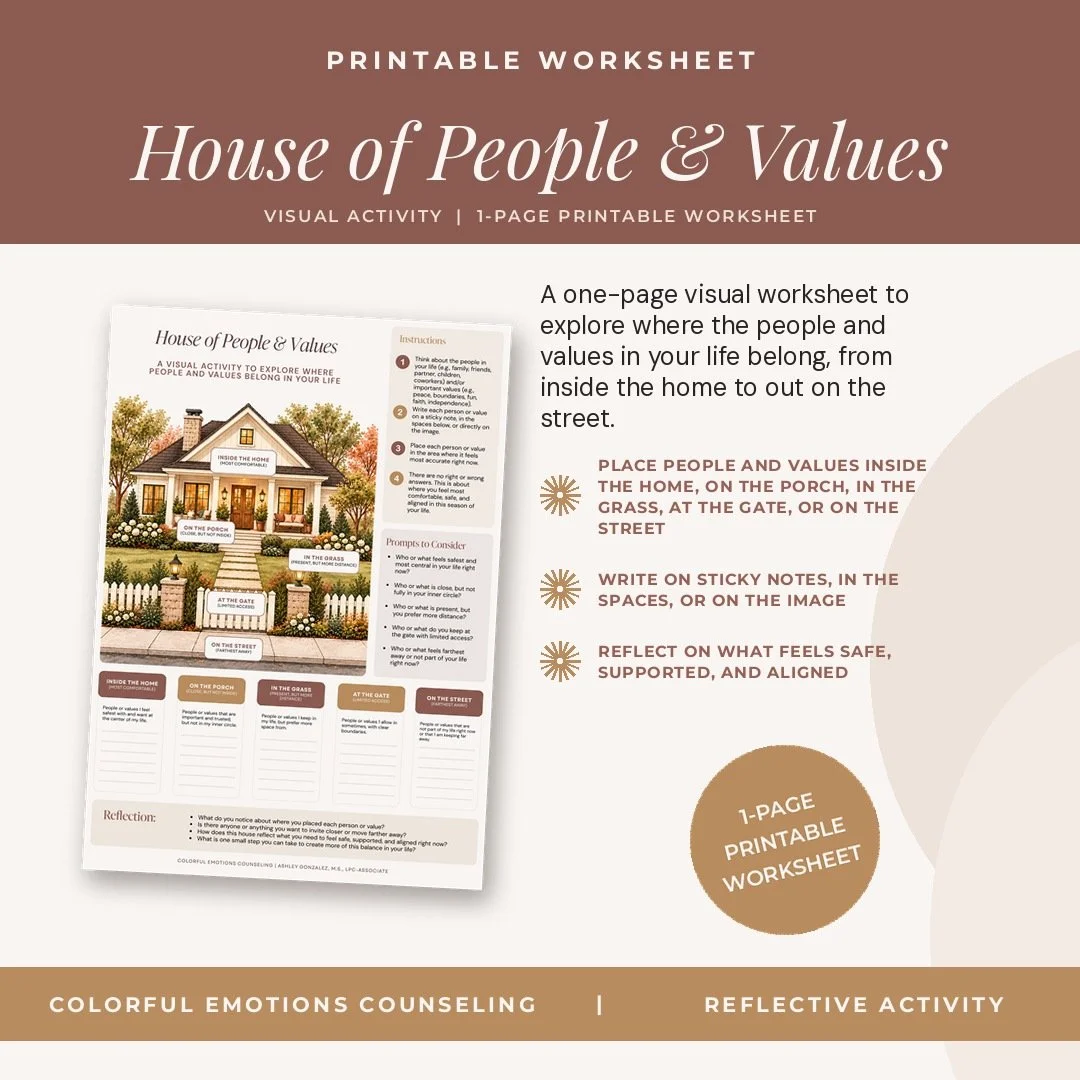
Who is close to you right now? What do you want to keep a little farther away? You get to decide.
House of People & Values is a one-page visual worksheet that helps you explore where the people and values in your life belong, from inside the home to out on the street. Use the house illustration as a map: place each person or value where it feels most accurate right now, with no right or wrong answers.
WHAT THIS WORKSHEET HELPS YOU DO
Think it through: Consider the people in your life (like family, friends, partner, children, or coworkers) and/or important values (like peace, boundaries, fun, faith, or independence).
Place each one: Choose a zone that feels most accurate right now. Inside the Home (most comfortable), On the Porch (close, but not inside), In the Grass (present, but more distance), At the Gate (limited access), or On the Street (farthest away).
Write it down your way: Use sticky notes, the writing columns on the page, or write directly on the image.
Reflect: Use the prompts and reflection questions to notice what you see, who or what you might invite closer or move farther away, and one small step you can take.
WHAT'S INCLUDED
1-page printable worksheet (A4, digital download)
Step-by-step instructions
House illustration with five zones
Five writing columns, one for each zone
Five prompts to consider
Four reflection questions
Delivery: Instant digital download. No physical item will be shipped.
WHO IS THIS FOR?
Adults who want a calm, visual way to reflect on relationships, boundaries, and personal values. It is written for individuals, and a therapist or counselor may also choose to use it in session.
HOW TO USE
1. Purchase and download your PDF.
2. Print it, or write on it with a PDF or note-taking app. Sticky notes work well too.
3. Take a few quiet minutes to place each person or value, then answer the reflection questions. You can come back to it as this season of your life changes.
IMPORTANT INFORMATION
This worksheet is for self-reflection and educational use only and is not a substitute for professional mental health care. It is not a diagnostic tool, medical advice, or treatment. If you are in crisis, call or text 988 or call 911. © 2026 Colorful Emotions Counseling. Personal use only. Do not copy, share, resell, or redistribute.

How do you reach for people when you need them? What do you do when closeness feels like too much, or when distance feels like too little? You get to explore it at your own pace.
Understanding Your Attachment Style is a 23-page printable workbook that offers a calm, curious way to notice your own relationship patterns. You will read about four common attachment styles in plain language, reflect on what feels familiar, and practice small skills for communicating needs and feeling steadier in close relationships. You do not need to fit neatly into one style. Many people recognize pieces of more than one.
WHAT THIS WORKBOOK HELPS YOU DO
Learn the four styles: Read plain-language descriptions of secure, anxious, avoidant, and disorganized (fearful-avoidant) patterns, including strengths that can come with them.
Notice your patterns: Use a gentle reflection page (not scored), a triggers and body cues page, and a thoughts, feelings, and actions map to see what happens in close relationships.
Practice needs and boundaries: Name what helps you feel connected and what helps you feel steady, and think through a boundary you would like to set or keep.
Find the words: Start from sample scripts for asking for reassurance or asking for space, then write your own.
Keep track: Use a weekly pattern tracker, relationship values page, and reflection page to look back over your week and your pages.
WHAT'S INCLUDED
23-page printable workbook (A4, digital download)
Welcome, Important Information, Copyright Notice, and How to Use This Workbook
What Is Attachment? and The Four Styles at a Glance
One page each for Secure, Anxious, Avoidant, and Disorganized (Fearful-Avoidant) attachment
What Resonates? A gentle reflection (not scored)
How Patterns Take Shape
My Triggers and Body Cues
Thoughts, Feelings, and Actions
My Needs and Boundaries
Practices for Earned Security
Scripts for Reassurance and Space
My Relationship Values
Weekly Pattern Tracker
Reflection page and Closing: Where to Go from Here
Delivery: Instant digital download. No physical item will be shipped.
WHO IS THIS FOR?
Adults who want a calm, gentle way to reflect on how they connect, protect, and reach for the people who matter to them in friendships, family relationships, and partnerships. It is written for individuals, and a therapist or counselor may also choose to use it in session.
HOW TO USE
1. Purchase and download your PDF.
2. Print it, or type into it with a PDF or note-taking app.
3. Set aside 15 to 20 quiet minutes. Think about one relationship at a time, move through the pages in order or jump to what you need, and skip anything that does not fit. You can come back to it in a few weeks, as your answers may change.
IMPORTANT INFORMATION
This workbook is for self-reflection and educational use only and is not a substitute for professional mental health care. Attachment styles are patterns, not labels. This is not a diagnostic tool, medical advice, or therapy, and it cannot diagnose, assess, or treat any condition. Some reflections may bring up strong feelings, and you can pause or skip any page. If you are in crisis, call or text 988 or call 911. © 2026 Colorful Emotions Counseling. Personal use only. Do not copy, share, resell, or redistribute.